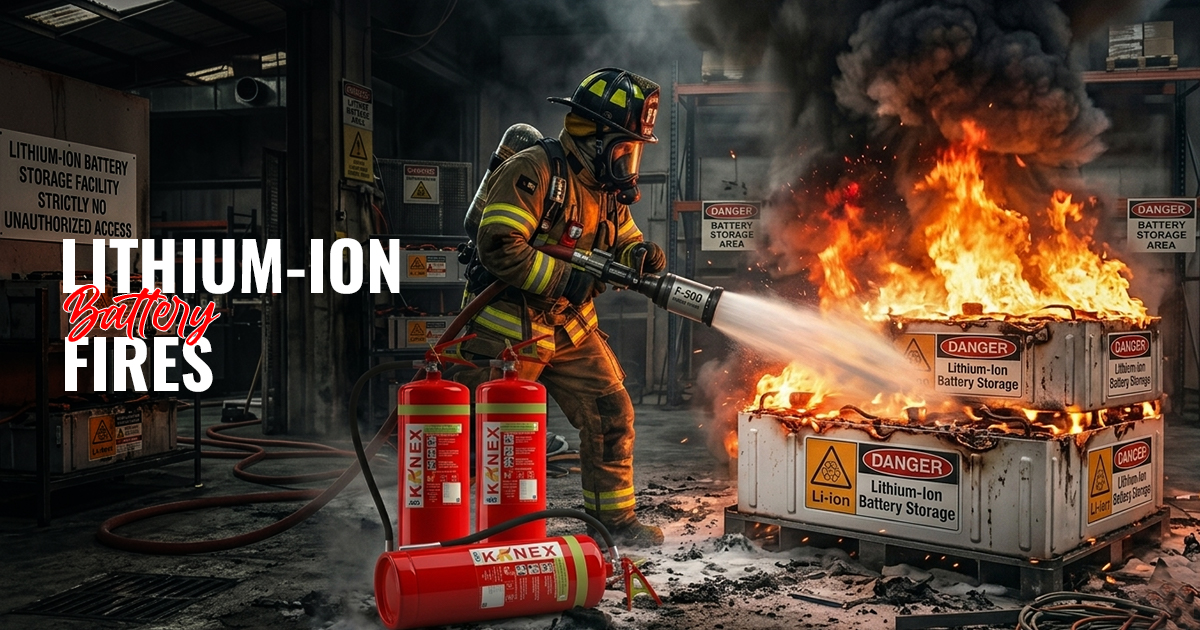
Lithium-Ion Battery Fires: Why Traditional Extinguishers Fail and What Works
- May 27, 2026
Your e-bike bursts into flames in the parking lot. An EV smoulders in a basement garage for hours, long after everyone thought it was out. These are not normal cases anymore.
Lithium-ion battery fires surged by 93% between 2022 and 2024, and the fire safety industry is still catching up. Let’s learn more about this in this guide.
What Makes Lithium-Ion Battery Fires Different?
Every fire you have ever seen follows the same basic rule: take away fuel, oxygen, or heat and the fire dies.
But, lithium-ion battery fires ignore this rule entirely. When something goes wrong inside the battery, a chain reaction called thermal runaway kicks in. The battery starts generating its own oxygen internally, so the fire feeds itself from the inside out. You cannot starve it. You cannot simply cool the surface and walk away.
Why Lithium-Ion Fires Are More Dangerous
EV fires burn at around 5,000°F, more than three times hotter than a petrol car fire, and need roughly ten times the water to put out. But the temperature is not even the worst part.
A battery can reignite minutes, hours, or even days after the fire appears to be out, because the electrochemical reaction inside keeps going whether the flames are visible or not. Firefighters have learned this the hard way.
Why Traditional Fire Extinguishers Fail
Most fire fighting equipment on the market today was designed for fires with a clear external fuel source.
For example:
- CO2 cuts off oxygen, dry powder knocks back flames, water absorbs heat.
- None of these get anywhere near the actual problem with a lithium battery fire, which is happening inside the cells themselves.
- Water can intensify a lithium battery fire by reacting with lithium compounds and releasing toxic gases. So the thing most people reach for first can make the situation worse.
What Works for Lithium-Ion Battery Fires
Specialist lithium-ion fire extinguishers using Aqueous Vermiculite Dispersion (AVD) are the most effective option for smaller fires. AVD cools the cells and wraps them in a mineral layer that interrupts the chain reaction at the source.
For larger risks, EV parking facilities, data centers, and battery energy storage system installations need fixed suppression systems with dedicated cooling agents. These are not upgrades to standard setups. They are completely different systems built for a completely different class of fire.
Where Lithium-Ion Fire Risks Exist
- EV charging stations and parking garages
- E-bike and e-scooter storage areas
- Data centers and server rooms
- Warehouses with battery energy storage system installations
- Factories assembling or recycling lithium batteries
Prevention: The First Line of Defence
- Use only manufacturer-approved chargers
- Avoid overnight charging without supervision
- Replace swollen or damaged batteries immediately
- Install heat detectors in all charging zones
Final Say
Standard fire extinguishers and basic fire safety setups were designed for a different era of risk. Lithium-ion battery fires require purpose-built suppression systems, the right lithium-ion fire extinguishers, and personnel who understand the risks of re-ignition.
Get those three right and you have a real plan. Miss any one of them and a contained incident becomes something far worse.
FAQs
AVD-based lithium-ion fire extinguishers cool the battery cells and coat them in a mineral layer that stops thermal runaway from spreading. Standard agents cannot reach the internal reaction. AVD gets close enough to actually matter.
No. A general extinguisher can knock back visible flames but does nothing to stop the reaction happening inside the cells. For larger battery packs, immersion cooling is generally the only method with a real chance of preventing re-ignition.
Because the fire is not on the surface. Thermal runaway is an electrochemical event inside the battery generating its own heat and oxygen. Standard fire fighting equipment is designed to work from the outside in. But lithium fires work from the inside out.
Yes. During thermal runaway, battery cells overheat, chain-react, and can explode. Self-generated oxygen and re-ignition risk lasting days make EV fires nearly impossible to control with standard equipment.
You may also Like