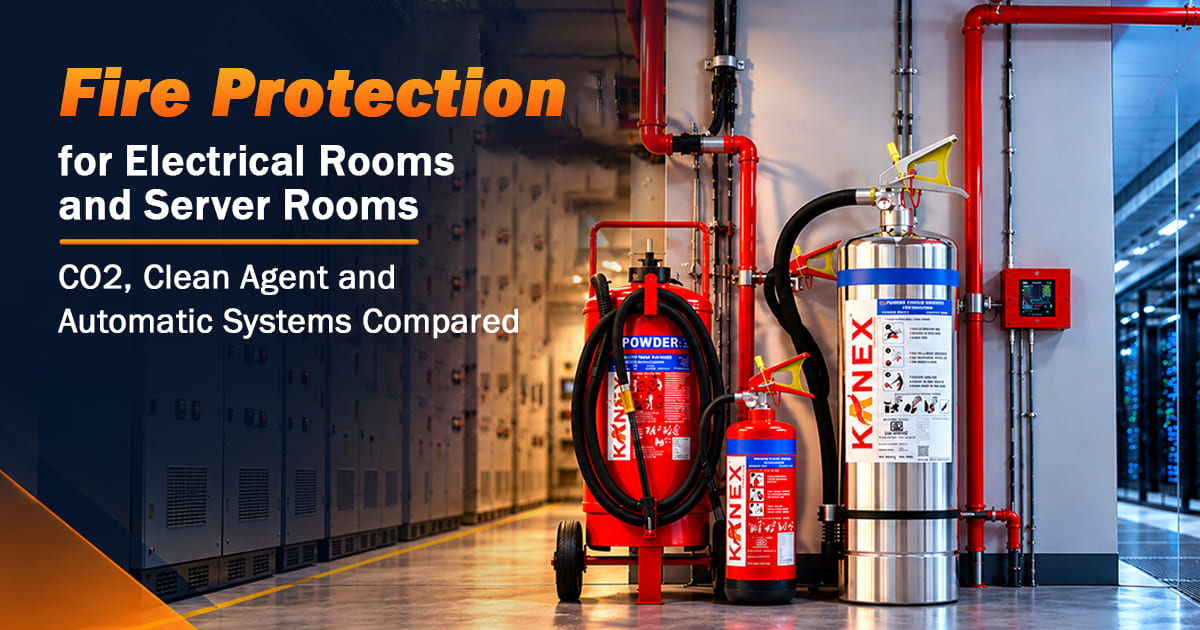
Fire Protection for Electrical Rooms and Server Rooms: CO₂, Clean Agent and Automatic Systems Compared
- October 30, 2026
Key highlights: fire protection for electrical rooms and server rooms
- CO₂ is for unoccupied electrical rooms: transformer vaults, cable trenches, switchgear. Not for rooms where people regularly enter.
- For active server rooms, clean agent is the right choice. It suppresses fire without removing oxygen, so the space remains safe during discharge.
- FM-200 and Novec 1230 (FK-5-1-12) are both clean agents. FK-5-1-12 has a wider human safety margin and a GWP under 1.
- IS 12456:2004 is the controlling standard for server room fire protection in India, not IS 2189. Most facility specs cite the wrong code.
- An automatic suppression system is a full detection-to-discharge sequence: VESDA detection, a 30- to 60-second evacuation window, then agent discharge in about 10 seconds. It does not replace portable extinguishers. Both are required.
This article compares CO₂ systems, clean agent systems, and automatic fire suppression for server rooms, and which Indian standards apply to each. And which Indian standards apply to each.
Why Electrical Rooms and Server Rooms Need a Different Fire Strategy
Electrical rooms, server rooms, UPS rooms, and switchgear enclosures have three overlapping risks: electrical fire from energised equipment, business loss from equipment damage, and occupant danger if people are present during suppression.
Both water and dry powder cause secondary damage. The suppression agent must be non-conductive, leave no residue, and discharge fast.
IS 12456:2004 is the Bureau of Indian Standards specification that governs fire protection for electronic data processing installations. It is the controlling standard for server room and computer room fire protection. It is not just IS 2189:2008, which covers detection and alarm systems alone.
CO₂ Fire Suppression Systems: Where They Work and Where They Don’t
CO₂ total flooding displaces oxygen below the level needed to sustain combustion. It leaves no residue and doesn’t damage electrical systems. For unoccupied spaces, it is an effective and cost-efficient choice.
Fixed CO₂ suppression systems fall under IS 15528:2004. IS 15683 covers portable CO₂ extinguishers and replaced the now-withdrawn IS 2878:2004 standard. Confirm the currently active revision and amendments through the BIS portal before procurement
Limitations of CO₂ in Occupied Spaces
CO₂ at 10% concentration can cause unconsciousness within a minute. Total flooding systems discharge at 34-50% concentration. That is immediately dangerous to anyone still in the room.
CO₂ is not a suitable primary suppression choice for occupied or regularly entered server rooms unless the design includes hard access interlocks, evacuation alarms, mandatory time delays, and a formal risk assessment. For those spaces, clean agent is the right call.
Clean Agent Systems: FM-200 vs Novec 1230
Clean agents suppress fire by absorbing heat, not by removing oxygen. The room stays breathable. And equipment can be brought back online within hours.
FM-200 (HFC-227ea) has a design concentration of about 6.7 to 7.0% and a NOAEL of 9%, leaving roughly 2 percentage points between effective suppression and the human safety threshold.
Novec 1230 (FK-5-1-12) has a design concentration of approximately 4.2 to 4.5% and a NOAEL of 10%, a much wider margin. Its global warming potential is under 1, compared to FM-200’s GWP of approximately 3,220.
India ratified the Kigali Amendment in 2021. HFCs, including FM-200, face a production freeze from January 2028, with an 85% reduction target by 2047. Also worth noting: 3M exited FK-5-1-12 production by the end of 2025 due to PFAS liability concerns. Other manufacturers now offer the chemistry, though pricing has risen 12 to 18% since 2024.
When to Choose One over the Other
FM-200 suits existing system extensions and cost-constrained retrofits. For new installations, FK-5-1-12 is the stronger long-term choice, with a wider safety margin, lower design concentration, and no exposure to the HFC phase-down timeline.
Automatic Suppression Systems for Server Rooms
“Automatic” describes how a system operates. A clean agent server room system is almost always automatic. This distinction matters when comparing specifications.
How Total Flooding Works
Detection triggers first: typically a VESDA aspirating system sampling air at parts-per-million levels, confirmed by cross-zone spot detectors. On confirmed detection, HVAC shuts down, dampers close, and a pre-discharge alarm gives occupants 30 to 60 seconds to evacuate. The agent floods the room in approximately 10 seconds for clean agents.
Room integrity is critical. For example: gaps around doors, cable penetrations, and raised floor tiles allow the agent to escape before it reaches suppression concentration. IS 12456:2004 requires post-installation room integrity testing.
NBCS 2026 and What Changes for Data Centres
SP 7:2026 (National Building Code of India 2026), published April 2026, introduces a new data centre occupancy classification and strengthens fire protection requirements for these facilities.
Specific mandated clauses (compartment sizing, detection system requirements, suppression agent selection) should be verified directly against the BIS-published text of SP 7:2026 and confirmed with the local Authority Having Jurisdiction before system design begins. Secondary summaries of code requirements have compliance risk.
CO₂ vs Clean Agent vs Automatic: Direct Comparison
Here is the side-by-side comparison of these systems. Choose carefully:
| Factor | CO₂ | Clean Agent | Automatic System |
| Occupied spaces | Not suitable without major safeguards | Suitable | Depends on agent chosen |
| Residue | None | None | Depends on agent |
| IS standard | IS 15493:2004 | IS 15493:2004 | IS 12456:2004 |
| Environmental profile | Greenhouse gas | FM-200: high GWP. FK-5-1-12: very low GWP | Depends on agent |
| Best for | Unoccupied electrical and industrial spaces | Server rooms, data centres, control rooms | Full engineered system for critical spaces |
Choosing the Right System for Your Facility
For unoccupied switchgear rooms and cable vaults: CO₂ with proper access control and life-safety design is appropriate and cost-effective.
For occupied server rooms and data centres: FK-5-1-12 with VESDA detection and automatic discharge is the current standard for new builds. FM-200 remains viable for retrofits where the existing system is being extended.
For battery and UPS rooms: lithium-ion thermal runaway requires specialised detection and suppression design. Standard clean agent discharge may not be sufficient. Because this needs a separate hazard assessment.
In all spaces, portable extinguishers remain a mandatory first-response complement to any fixed system. Portable CO₂ and clean agent units should meet the current applicable IS certification confirmed through BIS.
Contact Kanex Fire for compliant fire suppression systems built to IS standards.
FAQs
Which is better for a server room: CO₂ or clean agent suppression?
Clean agent is the better choice for occupied server rooms. CO₂ at 34-50% concentration is dangerous. Clean agents like FK-5-1-12 suppress fire without displacing oxygen.
Is CO₂ fire suppression safe to use in rooms where people work?
No. CO₂ at 10% concentration can cause unconsciousness in under a minute. Fixed CO₂ systems should be used only in unoccupied spaces, with hard interlocks and strict access control.
What does IS 2878 cover for CO₂ extinguishers in India?
IS 2878:2004 covered the construction, capacity, and testing of portable CO₂ extinguishers. BIS has since listed it as withdrawn. Confirm the current applicable standard through the BIS portal before procurement.
What is the difference between FM-200 and Novec 1230 for data centres?
Both suppress fire through heat absorption. FM-200 has a GWP of 3,220 and faces India’s HFC freeze from 2028. FK-5-1-12 has a GWP under 1 and a wider human safety margin.
Does an automatic suppression system replace portable fire extinguishers?
No. Fixed systems handle total flooding. Portable extinguishers cover first response and areas outside the suppression zone. IS 12456:2004 and NBCS 2026 both require them alongside fixed systems.